Mission Control for AI Websites
Let AI scale your website,
without losing control.
Claude Code, Codex, or Gemini on the repo and host you already run. Every change previewed, approved, attributed, and reversible. Nothing to replatform.
No credit card needed ✦ Free plan available
How it works
Your agent builds. Your team approves.
Every change runs through the same record, previews, and one-click restore.
Decision
Add a meta description to /about
Pricing FAQ: annual plan
a41f09c · Claude Code
Approve, ship, restore.
Roles, risk tiers, and a record of who changed what. Undo is one click.
AEO score dropped on /pricing
Fix drafted, ready for review
Work that finds you.
Dispatch crawls, scores, and drafts the fix before anyone asks.
- Claude Code
- Codex
- Gemini
- GitHub
- Vercel
- Netlify
- Cloudflare
Bring your own agent.
Your agent, your repo, your host. Nothing to migrate, nothing to learn twice.
Built for the team, not just the engineer
Multiplayer mode for your website.
People and agents working at once, on the same site, without colliding or losing track of who did what.
- Every request on its own branch: nobody overwrites anyone, and previews stay separate.
- Agents follow the same rules as people: roles decide who approves, and high-risk work needs two.
- One Inbox for the whole team: approvals, findings, and drafts in one place, plus Slack when you are needed.
- Any agent, one record: Claude Code, Codex, or Gemini today, something else tomorrow, all attributed.
Requests
4 open · 2 agents working · 1 needs you
req-7c21e0d4 · Pricing FAQ: annual plan
Claude Codebuildingreq-9a11c3f2 · Add case study to /work
Codexpreview readyApprovereq-4d8e0b77 · Fix meta descriptions (finding)
Drafted by DispatchAnareviewingreq-b03fe1a9 · Homepage hero copy
Jimhigh risk · 1 of 2 approvals
Bring your own agent. BYOA. Keep your own stack.
Any agent. Any host. Nothing to switch.
Your agent writes the change. GitHub keeps the code, Sanity keeps the content. Vercel, Netlify, or Cloudflare ships it. Dispatch sits above all of them and governs the work. Switch any of them and nothing on the record changes: the approvers, the risk tiers, and the restore path stay with the website.
 Claude
 ChatGPT
 Gemini
 GitHub
 Sanity
 Astro
Astro Vercel
 Netlify
 Cloudflare
 Slack
Slack
AI-native website migration
Move beyond your CMS.
Operate your website with AI.
Most teams who want an AI-native website do not have one yet. We assess your site, recommend the right architecture, migrate it, and connect it to Dispatch.
Architecture
Astro + Cloudflare
Recommended for youAstro + Netlify
Next.js + Vercel
Pick the right stack.
Astro on Cloudflare or Netlify for content-led sites, Next.js on Vercel for app-like ones. We recommend, because we sell none of them.
Pixel check
26 of 26 pages match
/
Match/services
Match/blog/what-to-expect
Match
Move it pixel for pixel.
Every page verified against your live site before cutover. Your content, URLs, redirects, and rankings come with you.
Connection
GitHub
OKHost
OKPages scored
46Approvals
On
Governed on day one.
Repo connected, host connected, pages scored, approvals on. Your agent starts work the week you land.
Still on a CMS?
We move you to a site AI can run.
Assessment, architecture, pixel-for-pixel move, and Dispatch connected at cutover. A one-time project with a fixed quote, scoped by Dispatch and delivered by an agency in the partner program.
Already on code?
Connect it today.
A GitHub repo on Vercel, Netlify, or Cloudflare connects in minutes. No migration, nothing to move, free plan available.
The migration ends where the product begins: your site lands on the Team plan, first 90 days included, governed from the first commit. Either door lands on the same Inbox.
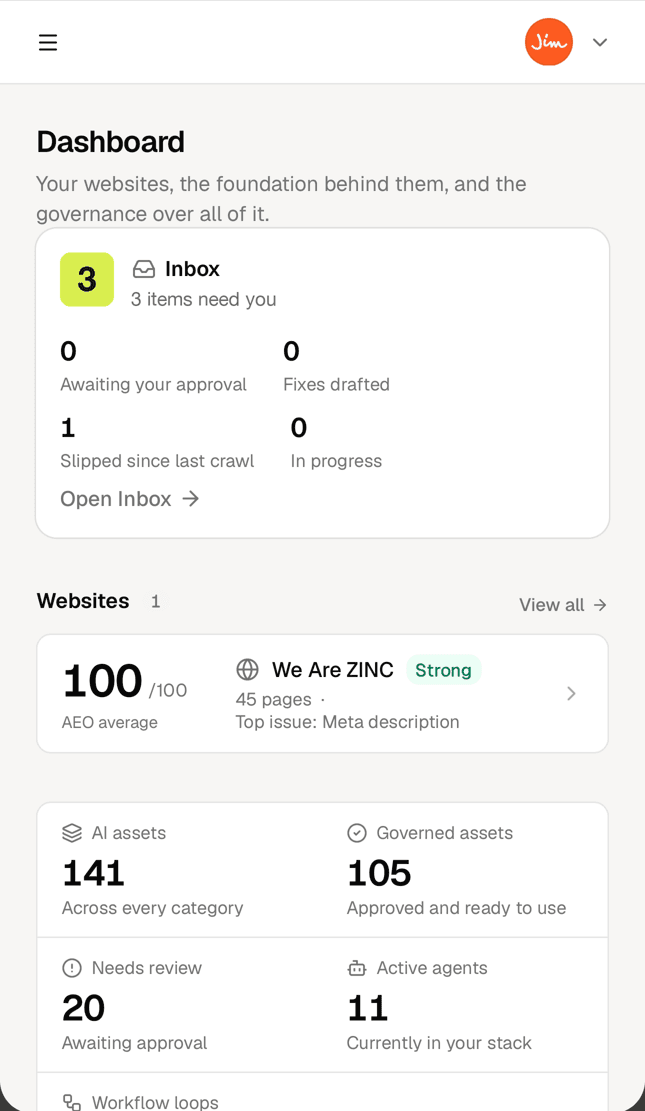
Everything you need to manage your AI website, even on the go.
Run your website top to bottom from any device, with a real record behind every change and a person in the loop when it matters.
- Inbox on your phone: Approve, send back, or restore from anywhere.
- Findings drafted for you: Dispatch flags what slipped and writes the fix.
- Every change on the record: Who asked, who approved, and one-click undo.
AEO visibility, built in
See your AEO performance, page by page.
A score for every page, a history for every score, and a drafted fix when one slips. Where you are improving and where you have a problem, always in view.
Watched every day.
Scheduled re-crawls keep a score history for every page. A drop of ten points or more lands in your Inbox with the fix already drafted.
/pricing · 30 crawls
A score for every page.
Zero to 100 on what answer engines read, rolled up to a site average and four grades.
84 /100
AEO average · 45 pages · re-crawled daily
- Strong28
- Good11
- Needs work5
- Poor1
- /96
- /about72
- /pricing58
Eight checks, weighted the way engines read.
Structured data counts most. Title, meta description, H1, canonical, social metadata, indexability, and status make up the rest.
- Title tag15
- Meta description15
- H1 heading10
- Canonical URL10
- Structured data20
- Social metadata10
- Indexable10
- HTTP status10
/pricing after the drop: canonical and structured data failing, social metadata partial.
Fix what matters first.
Top issues ranked by how many pages they touch, so the team starts where the score moves most.
- Meta description6 pages
- Structured data4 pages
- Canonical URL2 pages
- Social metadata2 pages
Company Brain
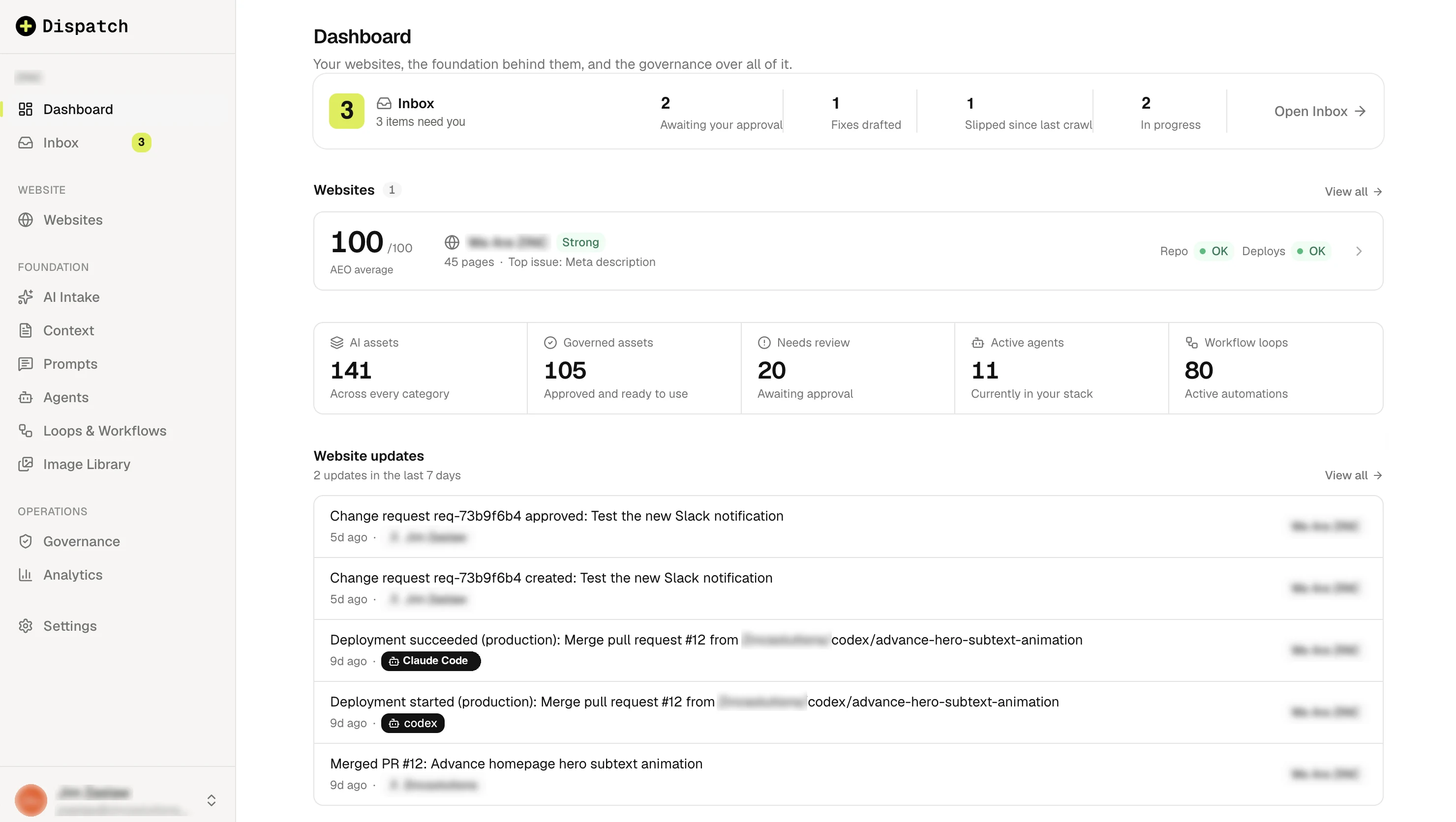
Your context and AI assets, managed in one place.
Every prompt, agent, workflow, image, and piece of context your team creates with AI, in one approved, shared library that the website runs on.
Context
Brand voice, product facts, and rules, attached to every request an agent receives.
Prompts
Versioned and approved before anyone reuses them, searchable across the team.
Agents
Configured once, governed by role, and attributed on every change they make.
Loops & Workflows
Multi-step automations that run on a schedule and land their output in the Inbox.
Image Library
Every AI image with the prompt that made it and the approval that cleared it.
Who sees the most benefit
Built for the people who ship the website.
Anyone can run a site on Dispatch. These three get the most out of it, because the website is their job and the developer queue is their problem.
For
Founders
You are the whole team, and your agent is the developer.
Plain-language requests, one-tap approvals, undo for everything.
For
Marketing teams
Ship the website yourself, every day, without a developer queue.
Every change previewed and approved by your own people.
For
Agencies
Orchestrate across every platform your clients use instead of being locked to one.
Migrate, govern, hand off, stay the partner.
The category, defined
What is the management layer for AI-powered websites?
New tools get names before they get definitions. This is the phrase you will see across this site, in one paragraph you can quote.
Read the longer answermanagement layer
nounfor AI-powered websites
The management layer for AI-powered websites is the system that sits above the coding agent, the repository, and the host. It records who asked for each change, what context shaped it, who approved it, what it did to the site, and how to undo it, so a team can let AI run the website without giving up control.
AI-powered website questions, answered.
Quick answers on running a website that AI agents build and your team governs. More in the Knowledge Center.
An AI-powered website is a site whose day-to-day changes are produced by AI coding agents, like Claude Code, Codex, or Gemini, working directly against the site's real codebase, instead of by hand through a CMS. The tools to build and run a website this way already exist; Dispatch makes them manageable for your organization by adding the visibility, context, approvals, and history around every change.
Your agent builds it. Your team approves it. Dispatch keeps it on the record.
Add your website, connect the agent you already use, and run your first governed change today. Dispatch finds what’s next from there.